Molecular mechnism: Drivers of Rapid Cell Fate Transitions
One intriguing phenomenon observed in hematopoiesis is that commitment to and appearance of the Meg lineage occurs more rapidly than other lineages (Sanjuan-Pla et al., 2013; Yamamoto et al., 2013). However, the mechanisms underlying this process remain elusive. To mechanistically dissect this finding, we focused on all cell types derived from the MEP-like lineage.
In this tutorial, we will guide you to
learn vector field and manually select fixed points
visualize topography with computed fixed points
compute pseudotime (potential)
visualize vector field pseudotime of cell types
Import relevant packages
import warnings
warnings.filterwarnings('ignore')
warnings.filterwarnings("ignore", message="numpy.dtype size changed")

import dynamo as dyn

dyn.configuration.set_figure_params('dynamo', background='white')
dyn.pl.style(font_path='Arial')
dyn.get_all_dependencies_version()

%load_ext autoreload
%autoreload 2
Using already downloaded Arial font from: /tmp/dynamo_arial.ttf
Registered custom font as: Arial


 ███                               ████████
█████   █████    █████    █████    ███   █████
   ██████   ██████   ██████   ████████      ████
  ___                           ████            ███
 |   \ _  _ _ _  __ _ _ __  ___                 ███
 | |) | || | ' \/ _` | '  \/ _ \█████           ███
 |___/ \_, |_||_\__,_|_|_|_\___/█████       ████
       |__/                        ███   █████
Tutorial: https://dynamo-release.readthedocs.io/
                                     █████
| package | umap-learn | typing-extensions | tqdm | statsmodels | setuptools | session-info | seaborn | scipy | requests | pynndescent | pre-commit | pandas | openpyxl | numdifftools | numba | networkx | mudata | matplotlib | loompy | leidenalg | igraph | dynamo-release | colorcet | anndata |
|---|---|---|---|---|---|---|---|---|---|---|---|---|---|---|---|---|---|---|---|---|---|---|---|---|
| version | 0.5.7 | 4.13.2 | 4.67.1 | 0.14.4 | 79.0.0 | 1.0.1 | 0.13.2 | 1.11.4 | 2.32.3 | 0.5.13 | 4.2.0 | 2.2.3 | 3.1.5 | 0.9.41 | 0.60.0 | 3.4.2 | 0.3.1 | 3.10.3 | 3.0.8 | 0.10.2 | 0.11.8 | 1.4.2rc1 | 3.1.0 | 0.11.4 |
adata_labeling = dyn.sample_data.hematopoiesis()
|-----> Downloading processed hematopoiesis adata
|-----> Downloading data to ./data/hematopoiesis.h5ad
|-----> in progress: 99.0945%|-----> [download] completed [44.2869s]
take a glance at what is in adata object. All observations, embedding layers and other data in adata are computed within dynamo. Please refer to other dynamo tutorials regarding how to obtain these values from metadata and raw new/total and (or) raw spliced/unspliced gene expression values.
A schematic of leveraging differential geometry
ranking genes (using either raw or absolute values) across all cells or in each cell group/state
gene set enrichment, network construction, and visualization
identifying top toggle-switch pairs driving cell fate bifurcations

Visualize topography
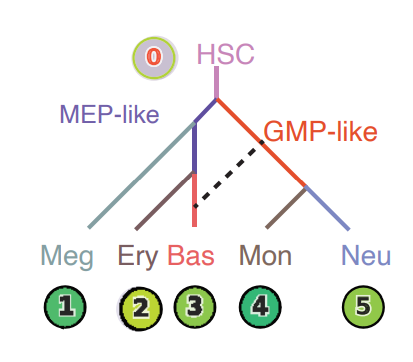
Lineage tree of hematopoiesis, lumped automatically from the vector field built in the UMAP space
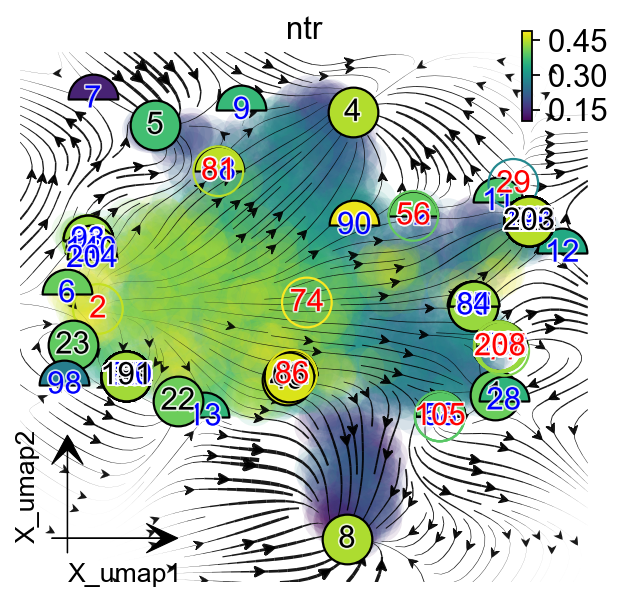
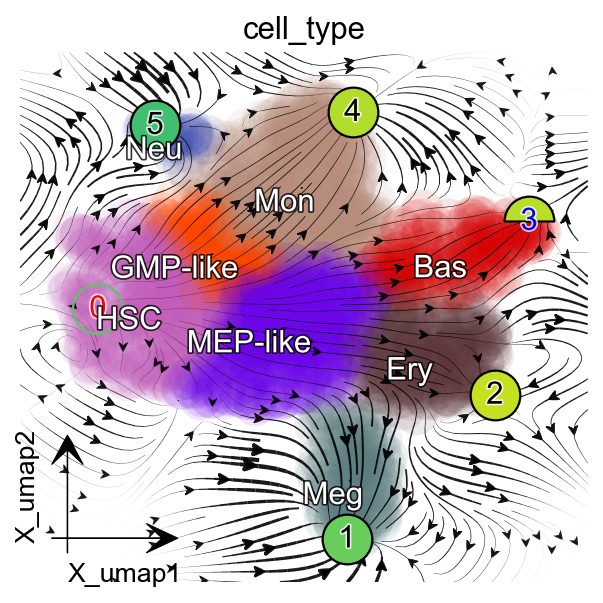
The reconstructed vector field and associated fixed points.
The color of digits in each node reflects the type of fixed point: red, emitting fixed point; black, absorbing fixed point. The color of the numbered nodes corresponds to the confidence of the fixed points.
Manually select good fixed points found by topography
adata_labeling.uns["VecFld_umap"].keys()
dict_keys(['C', 'E_traj', 'P', 'V', 'VFCIndex', 'X', 'X_ctrl', 'X_data', 'Xss', 'Y', 'beta', 'confidence', 'ctrl_idx', 'ftype', 'grid', 'grid_V', 'iteration', 'method', 'nullcline', 'sigma2', 'tecr_traj', 'valid_ind', 'xlim', 'ylim'])
dyn.vf.topography(adata_labeling, n=750, basis="umap")
|-----> method arg is None, choosing methods automatically...
|-----------> method kd_tree selected
AnnData object with n_obs × n_vars = 1947 × 1956
    obs: 'batch', 'time', 'cell_type', 'nGenes', 'nCounts', 'pMito', 'pass_basic_filter', 'new_Size_Factor', 'initial_new_cell_size', 'total_Size_Factor', 'initial_total_cell_size', 'spliced_Size_Factor', 'initial_spliced_cell_size', 'unspliced_Size_Factor', 'initial_unspliced_cell_size', 'Size_Factor', 'initial_cell_size', 'ntr', 'cell_cycle_phase', 'leiden', 'control_point_pca', 'inlier_prob_pca', 'obs_vf_angle_pca', 'pca_ddhodge_div', 'pca_ddhodge_potential', 'acceleration_pca', 'curvature_pca', 'n_counts', 'mt_frac', 'jacobian_det_pca', 'manual_selection', 'divergence_pca', 'curv_leiden', 'curv_louvain', 'SPI1->GATA1_jacobian', 'jacobian', 'umap_ori_leiden', 'umap_ori_louvain', 'umap_ddhodge_div', 'umap_ddhodge_potential', 'curl_umap', 'divergence_umap', 'acceleration_umap', 'control_point_umap_ori', 'inlier_prob_umap_ori', 'obs_vf_angle_umap_ori', 'curvature_umap_ori'
    var: 'gene_name', 'gene_id', 'nCells', 'nCounts', 'pass_basic_filter', 'use_for_pca', 'frac', 'ntr', 'time_3_alpha', 'time_3_beta', 'time_3_gamma', 'time_3_half_life', 'time_3_alpha_b', 'time_3_alpha_r2', 'time_3_gamma_b', 'time_3_gamma_r2', 'time_3_gamma_logLL', 'time_3_delta_b', 'time_3_delta_r2', 'time_3_bs', 'time_3_bf', 'time_3_uu0', 'time_3_ul0', 'time_3_su0', 'time_3_sl0', 'time_3_U0', 'time_3_S0', 'time_3_total0', 'time_3_beta_k', 'time_3_gamma_k', 'time_5_alpha', 'time_5_beta', 'time_5_gamma', 'time_5_half_life', 'time_5_alpha_b', 'time_5_alpha_r2', 'time_5_gamma_b', 'time_5_gamma_r2', 'time_5_gamma_logLL', 'time_5_bs', 'time_5_bf', 'time_5_uu0', 'time_5_ul0', 'time_5_su0', 'time_5_sl0', 'time_5_U0', 'time_5_S0', 'time_5_total0', 'time_5_beta_k', 'time_5_gamma_k', 'use_for_dynamics', 'gamma', 'gamma_r2', 'use_for_transition', 'gamma_k', 'gamma_b'
    uns: 'PCs', 'VecFld_pca', 'VecFld_umap', 'X_umap_neighbors', 'cell_phase_genes', 'cell_type_colors', 'dynamics', 'explained_variance_ratio_', 'feature_selection', 'grid_velocity_pca', 'grid_velocity_umap', 'grid_velocity_umap_ori_perturbation', 'grid_velocity_umap_test', 'jacobian_pca', 'leiden', 'neighbors', 'pca_mean', 'pp', 'response'
    obsm: 'X', 'X_pca', 'X_pca_SparseVFC', 'X_umap', 'X_umap_SparseVFC', 'X_umap_ori_perturbation', 'X_umap_test', 'acceleration_pca', 'acceleration_umap', 'cell_cycle_scores', 'curvature_pca', 'curvature_umap', 'j_delta_x_perturbation', 'velocity_pca', 'velocity_pca_SparseVFC', 'velocity_umap', 'velocity_umap_SparseVFC', 'velocity_umap_ori_perturbation', 'velocity_umap_test'
    layers: 'M_n', 'M_nn', 'M_t', 'M_tn', 'M_tt', 'X_new', 'X_total', 'velocity_alpha_minus_gamma_s'
    obsp: 'X_umap_connectivities', 'X_umap_distances', 'connectivities', 'cosine_transition_matrix', 'distances', 'fp_transition_rate', 'moments_con', 'pca_ddhodge', 'perturbation_transition_matrix', 'umap_ddhodge'
dyn.pl.topography(
    adata_labeling,
    markersize=500,
    basis="umap",
    fps_basis="umap",
    streamline_alpha=0.9,
    s_kwargs_dict={'adjust_legend':True},
    figsize=(4,4)
)
|-----------> plotting with basis key=X_umap
In the resulted dictionary, Xss stands for the fixed points coordinates and ftype is the specific fixed point type, denoted by integers.
ftype value mapping:
-1: stable
0: saddle
1: unstable
Xss, ftype = adata_labeling.uns["VecFld_umap"]["Xss"], adata_labeling.uns["VecFld_umap"]["ftype"]
# good_fixed_points = [0, 2, 5, 29, 11, 28] # n=250
good_fixed_points = [2, 8, 1, 195, 4, 5]  # n=750

adata_labeling.uns["VecFld_umap"]["Xss"] = Xss[good_fixed_points]
adata_labeling.uns["VecFld_umap"]["ftype"] = ftype[good_fixed_points]
dyn.pl.topography(
    adata_labeling,
    markersize=500,
    basis="umap",
    fps_basis="umap",
    #   color=['pca_ddhodge_potential'],
    color=["cell_type"],
    streamline_alpha=0.9,
    s_kwargs_dict={'adjust_legend':True},
    figsize=(4,4)
)
|-----------> plotting with basis key=X_umap
|-----------> skip filtering cell_type by stack threshold when stacking color because it is not a numeric type
Vector field pseudotime
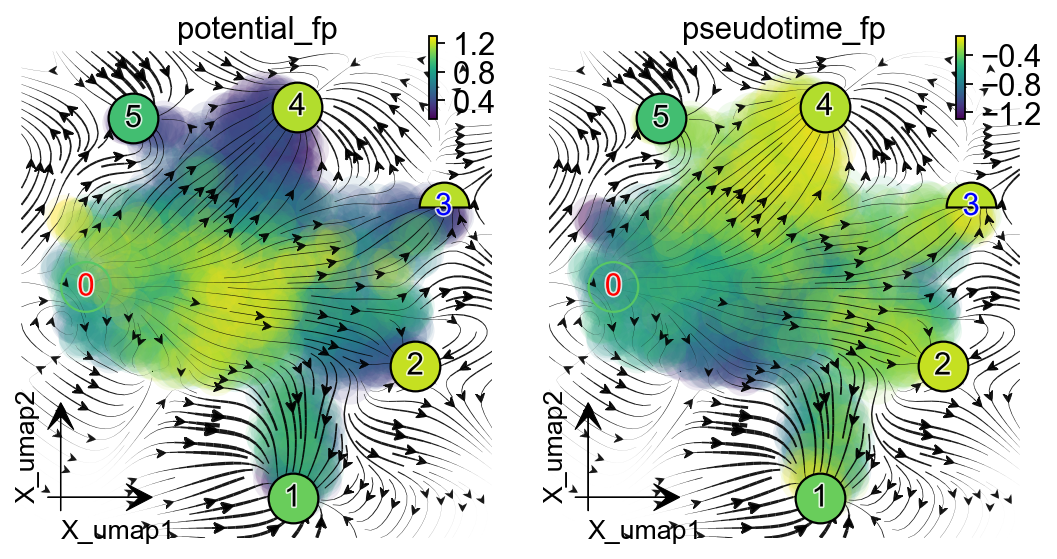
In this section, we will show how to visualize vector field pseudotime with dynamo. The vector field pseudotime is calculated based on the velocity transition matrix.
Define a colormap we will use later
dynamo_color_dict = {
    "Mon": "#b88c7a",
    "Meg": "#5b7d80",
    "MEP-like": "#6c05e8",
    "Ery": "#5d373b",
    "Bas": "#d70000",
    "GMP-like": "#ff4600",
    "HSC": "#c35dbb",
    "Neu": "#2f3ea8",
}
Initialize a Dataframe object that we will use to plot with visualization packages such as sns
valid_cell_type = ["HSC", "MEP-like", "Meg", "Ery", "Bas"]
valid_indices = adata_labeling.obs["cell_type"].isin(valid_cell_type)
df = adata_labeling[valid_indices].obs[["pca_ddhodge_potential", "umap_ddhodge_potential", "cell_type"]]
df["cell_type"] = list(df["cell_type"])
Building a graph, computing divergence and potential with graph_operators in dynamo
from dynamo.tools.graph_operators import build_graph, div, potential

g = build_graph(adata_labeling.obsp["cosine_transition_matrix"])
ddhodge_div = div(g)
potential_cosine = potential(g, -ddhodge_div)
adata_labeling.obs["cosine_potential"] = potential_cosine
Compute potential_fp and store in the dataframe object df we created above. Note that fp stands for fokkerplanck method. Please refer to the dynamo cell paper for more details on the related methods.
g = build_graph(adata_labeling.obsp["fp_transition_rate"])
ddhodge_div = div(g)
potential_fp = potential(g, ddhodge_div)
set potential_fp and pseudotime_fp in adata.obs to visualize potential and time.
adata_labeling.obs["potential_fp"] = potential_fp
adata_labeling.obs["pseudotime_fp"] = -potential_fp
dyn.pl.topography(
    adata_labeling,
    markersize=500,
    basis="umap",
    fps_basis="umap",
    color=["potential_fp", "pseudotime_fp"],
    streamline_alpha=0.9,
    s_kwargs_dict={'adjust_legend':True,'dpi':80},
    figsize=(4,4)
)
|-----------> plotting with basis key=X_umap
|-----------> plotting with basis key=X_umap
import seaborn as sns
df["cosine"] = potential_cosine[valid_indices]
df["fp"] = potential_fp[valid_indices]
sns.displot(
    data=df,
    x="cosine",
    hue="cell_type",
    kind="ecdf",
    stat="count",
    palette=dynamo_color_dict,
    height=2.5,
    aspect=95.5 / 88.8,
)
#plt.xlim(0.0, 0.008)
#plt.ylim(0, 12)
#plt.xlabel("vector field pseudotime")
<seaborn.axisgrid.FacetGrid at 0x7f575aba1cf0>
import matplotlib.pyplot as plt
sns.displot(
    data=df,
    x="cosine",
    hue="cell_type",
    kind="ecdf",
    stat="count",
    palette=dynamo_color_dict,
    height=2.5,
    aspect=95.5 / 88.8,
)
plt.xlim(0.0, 0.008)
plt.ylim(0, 12)
plt.xlabel("vector field pseudotime")
Text(0.5, 12.355555555555553, 'vector field pseudotime')
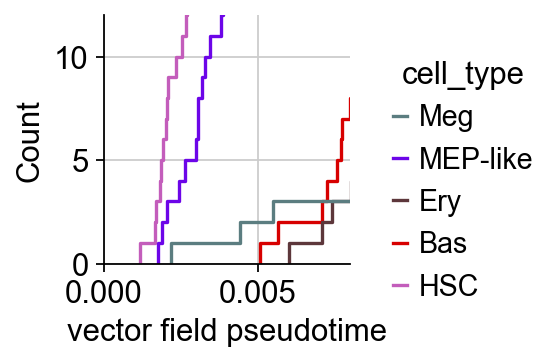
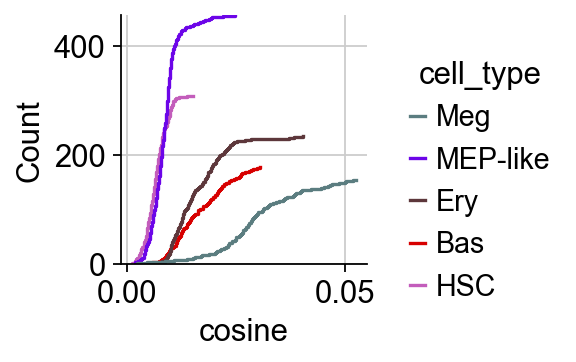
Via the visualization results above from vectorfield analysis, we can observe that egakaryocytes appear earliest among the Meg, Ery, and Bas lineages.
Molecular mechanisms underlying the early appearance of the Meg lineage
In this section, we will show:
Self- activation of FLI1
Repression of KLF1 by FLI1
FLI1 represses KLF1
Speed, acceleration and divergence calculation and visualization
Schematic summarizing the interactions involving FLI1 and KLF1.
Meg_genes = ["FLI1", "KLF1"]
Compute jacobian of selected genes
dyn.vf.jacobian(adata_labeling, regulators=Meg_genes, effectors=Meg_genes)
AnnData object with n_obs × n_vars = 1947 × 1956
    obs: 'batch', 'time', 'cell_type', 'nGenes', 'nCounts', 'pMito', 'pass_basic_filter', 'new_Size_Factor', 'initial_new_cell_size', 'total_Size_Factor', 'initial_total_cell_size', 'spliced_Size_Factor', 'initial_spliced_cell_size', 'unspliced_Size_Factor', 'initial_unspliced_cell_size', 'Size_Factor', 'initial_cell_size', 'ntr', 'cell_cycle_phase', 'leiden', 'control_point_pca', 'inlier_prob_pca', 'obs_vf_angle_pca', 'pca_ddhodge_div', 'pca_ddhodge_potential', 'acceleration_pca', 'curvature_pca', 'n_counts', 'mt_frac', 'jacobian_det_pca', 'manual_selection', 'divergence_pca', 'curv_leiden', 'curv_louvain', 'SPI1->GATA1_jacobian', 'jacobian', 'umap_ori_leiden', 'umap_ori_louvain', 'umap_ddhodge_div', 'umap_ddhodge_potential', 'curl_umap', 'divergence_umap', 'acceleration_umap', 'control_point_umap_ori', 'inlier_prob_umap_ori', 'obs_vf_angle_umap_ori', 'curvature_umap_ori', 'cosine_potential', 'potential_fp', 'pseudotime_fp'
    var: 'gene_name', 'gene_id', 'nCells', 'nCounts', 'pass_basic_filter', 'use_for_pca', 'frac', 'ntr', 'time_3_alpha', 'time_3_beta', 'time_3_gamma', 'time_3_half_life', 'time_3_alpha_b', 'time_3_alpha_r2', 'time_3_gamma_b', 'time_3_gamma_r2', 'time_3_gamma_logLL', 'time_3_delta_b', 'time_3_delta_r2', 'time_3_bs', 'time_3_bf', 'time_3_uu0', 'time_3_ul0', 'time_3_su0', 'time_3_sl0', 'time_3_U0', 'time_3_S0', 'time_3_total0', 'time_3_beta_k', 'time_3_gamma_k', 'time_5_alpha', 'time_5_beta', 'time_5_gamma', 'time_5_half_life', 'time_5_alpha_b', 'time_5_alpha_r2', 'time_5_gamma_b', 'time_5_gamma_r2', 'time_5_gamma_logLL', 'time_5_bs', 'time_5_bf', 'time_5_uu0', 'time_5_ul0', 'time_5_su0', 'time_5_sl0', 'time_5_U0', 'time_5_S0', 'time_5_total0', 'time_5_beta_k', 'time_5_gamma_k', 'use_for_dynamics', 'gamma', 'gamma_r2', 'use_for_transition', 'gamma_k', 'gamma_b'
    uns: 'PCs', 'VecFld_pca', 'VecFld_umap', 'X_umap_neighbors', 'cell_phase_genes', 'cell_type_colors', 'dynamics', 'explained_variance_ratio_', 'feature_selection', 'grid_velocity_pca', 'grid_velocity_umap', 'grid_velocity_umap_ori_perturbation', 'grid_velocity_umap_test', 'jacobian_pca', 'leiden', 'neighbors', 'pca_mean', 'pp', 'response'
    obsm: 'X', 'X_pca', 'X_pca_SparseVFC', 'X_umap', 'X_umap_SparseVFC', 'X_umap_ori_perturbation', 'X_umap_test', 'acceleration_pca', 'acceleration_umap', 'cell_cycle_scores', 'curvature_pca', 'curvature_umap', 'j_delta_x_perturbation', 'velocity_pca', 'velocity_pca_SparseVFC', 'velocity_umap', 'velocity_umap_SparseVFC', 'velocity_umap_ori_perturbation', 'velocity_umap_test'
    layers: 'M_n', 'M_nn', 'M_t', 'M_tn', 'M_tt', 'X_new', 'X_total', 'velocity_alpha_minus_gamma_s'
    obsp: 'X_umap_connectivities', 'X_umap_distances', 'connectivities', 'cosine_transition_matrix', 'distances', 'fp_transition_rate', 'moments_con', 'pca_ddhodge', 'perturbation_transition_matrix', 'umap_ddhodge'
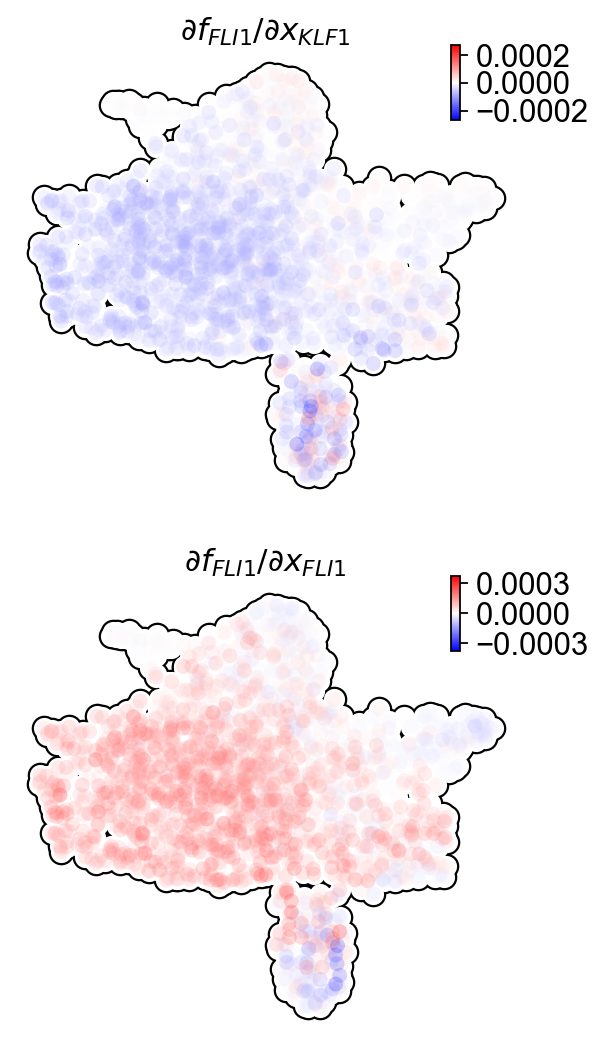
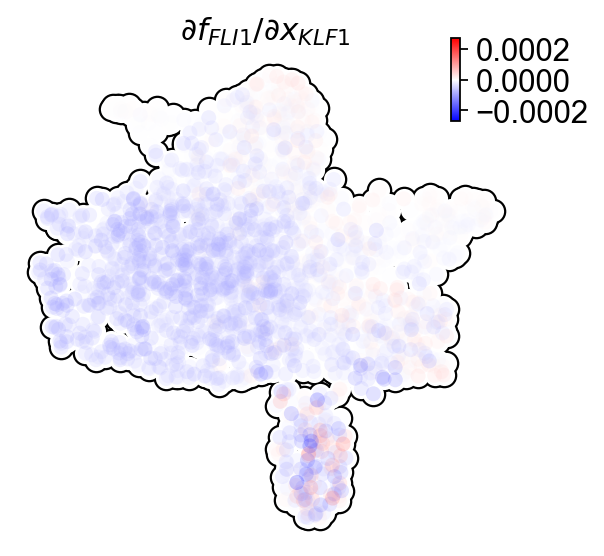
Next we use jacobian analyses to reveal mutual inhibition between FLI1 and KLF1 (Figure 5F) and self-activation of FLI1.
dyn.pl.jacobian(
    adata_labeling,
    regulators=Meg_genes,
    effectors=["FLI1"],
    basis="umap",
    figsize=(4,4)
)
dyn.pl.jacobian(
    adata_labeling,
    regulators=["KLF1"],
    effectors=["FLI1"],
    basis="umap",
    figsize=(4,4)
)
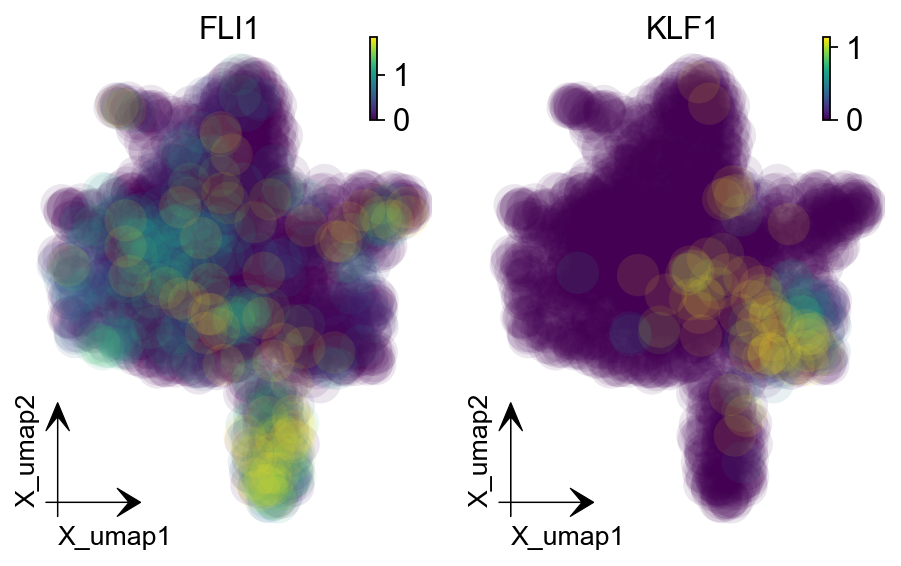
Expression of FLI1 (Meg lineage master regulator) relative to KLF1 (Ery lineage master regulator) in progenitors.
dyn.pl.umap(adata_labeling,
            color=["FLI1", "KLF1"],
            layer="X_total",figsize=(4,4),dpi=80,
           )
|-----------> plotting with basis key=X_umap
|-----------> plotting with basis key=X_umap
Computing and visualizing speed, divergence, acceleration and curvature
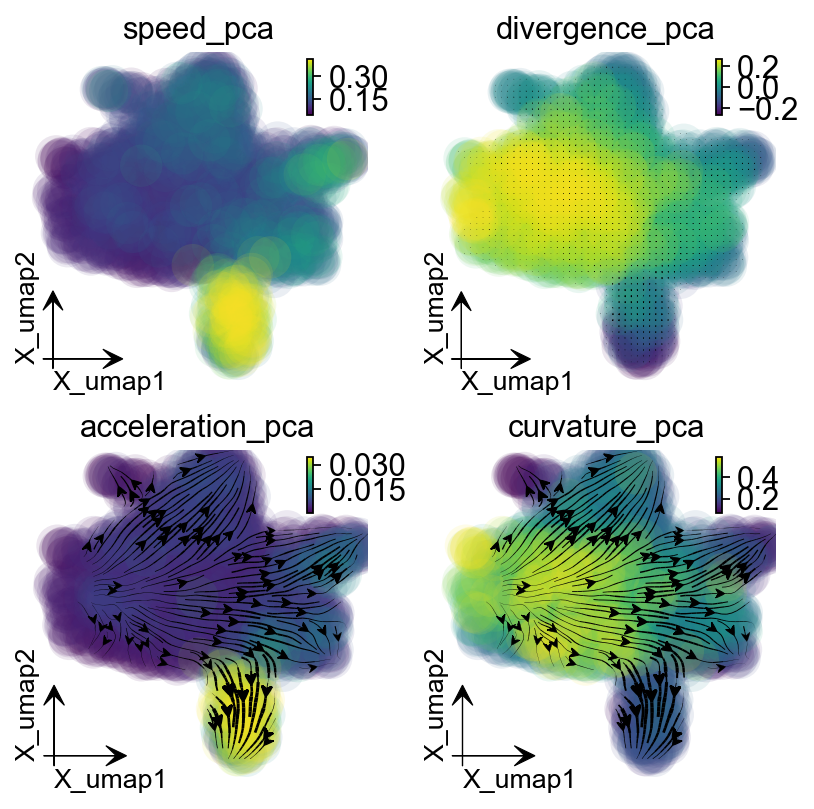
In this subsection we will show that megakaryocytes have the largest RNA speed (velocitymagnitude) among all celltypes.
Same as our other published notebook usage examples, we can use methods from dyn.vf to calculate speed, divergence, acceleration and curvature within specific basis. In the following code cell, we select pca as the basis.
basis = "pca"
dyn.vf.speed(adata_labeling, basis=basis)
dyn.vf.divergence(adata_labeling, basis=basis)
dyn.vf.acceleration(adata_labeling, basis=basis)
dyn.vf.curvature(adata_labeling, basis=basis)
|-----> [Calculating divergence with precomputed Jacobians] in progress: 100.0000%|-----> [Calculating divergence with precomputed Jacobians] completed [0.1374s]
|-----> [Calculating acceleration] in progress: 100.0000%|-----> [Calculating acceleration] completed [0.1043s]
|-----> [Calculating acceleration] in progress: 100.0000%|-----> [Calculating acceleration] completed [0.1229s]
|-----> [Calculating curvature] in progress: 100.0000%|-----> [Calculating curvature] completed [0.0974s]
adata_labeling.obs["speed_" + basis][:5]
barcode
CCACAAGCGTGC-JL12_0    0.116313
CCATCCTGTGGA-JL12_0    0.410604
CCCTCGGCCGCA-JL12_0    0.086653
CCGCCCACCATG-JL12_0    0.145851
CCGCTGTGTAAG-JL12_0    0.096051
Name: speed_pca, dtype: float64
The results are saved to {quantity}_{basis} (e.g. speed_pca). Then we can visualize via various visualization results.
In the result below, we can observe the patterns of dynamics quantities including speed are consistent with the function of FLI1 (Meg lineage master regulator) and KLF1 (Ery
lineage master regulator).
import matplotlib.pyplot as plt

fig, axes = plt.subplots(ncols=2, nrows=2, constrained_layout=True, figsize=(6, 6))
axes
dyn.pl.umap(adata_labeling, color="speed_" + basis,
            ax=axes[0, 0], save_show_or_return="return")
dyn.pl.grid_vectors(
    adata_labeling,
    color="divergence_" + basis,
    ax=axes[0, 1],
    quiver_length=12,
    quiver_size=12,
    save_show_or_return="return",
)
dyn.pl.streamline_plot(adata_labeling, color="acceleration_" + basis,
                       ax=axes[1, 0], save_show_or_return="return")
dyn.pl.streamline_plot(adata_labeling, color="curvature_" + basis,
                       ax=axes[1, 1], save_show_or_return="return")
plt.show()
|-----------> plotting with basis key=X_umap
|-----> method arg is None, choosing methods automatically...
|-----------> method kd_tree selected
|-----------> plotting with basis key=X_umap
|-----> method arg is None, choosing methods automatically...
|-----------> method kd_tree selected
|-----------> plotting with basis key=X_umap
|-----> method arg is None, choosing methods automatically...
|-----------> method kd_tree selected
|-----------> plotting with basis key=X_umap
Conclusion: a schematic diagram summarizing the interactions involving FLI1 and KLF1
Analyses above collectively suggest self-activation of FLI1 maintains its higher expression in the HSPC state, which biases the HSPCs to first commit towards the Meg lineage with high speed and acceleration, while repressing the commitment into erythrocytes through inhibition of KLF1. Together with the mutual regulation we show ealier in this tutorial, we can generate the following schematic to summarize the gene network.
